Build a Vulnerability Management Program That Drives Remediation
Last updated August 10, 2026.
Most vulnerability programs do not stall because they lack findings. They stall because asset coverage is uncertain, priority means "highest CVSS first," ownership is unclear, exceptions never expire, and a closed ticket is treated as proof of a fixed exposure.
A useful program creates a decision system around those findings. It can answer five questions: Is the vulnerable component really present? Could an attacker reach or exploit it? What business service could be affected? Who owns the decision? What evidence proves the exposure was removed or deliberately accepted?
This guide gives GreenHat clients, security leaders, founders, and technology teams a practical operating model and a 90-day starting plan. It is tool-agnostic and informed by guidance from NIST, CISA, FIRST, and OWASP.
A scanner is not a vulnerability management program
Scanning is an important source of evidence, but it is only one part of the system. The OWASP Vulnerability Management Guide makes the distinction directly: buying a scanner does not create a program. A program also needs scope, asset context, decision rules, owners, remediation workflows, verification, and reporting.
Scanner-first programs usually create a large queue with weak business context. Teams work the easiest tickets, the same issues return, and leadership sees counts rather than a clear view of exposure. An operating program turns each material finding into a risk decision with an accountable owner and a defined closure test.
Scanner output compared with an operating program
| Decision point | Scanner output | Operating program |
|---|---|---|
| Unit of work | A finding or CVE | A vulnerable instance tied to an asset, service, and owner |
| Priority | Severity score | Exploitation, reachability, business impact, severity, and controls |
| Handoff | Report or ticket | Named owner, decision, response target, and escalation path |
| Closure | Ticket marked done | Fix or mitigation retested with evidence |
| Leadership view | Open and closed counts | Coverage, material exposure, flow, exceptions, and recurrence |
Run one closed loop from signal to proof
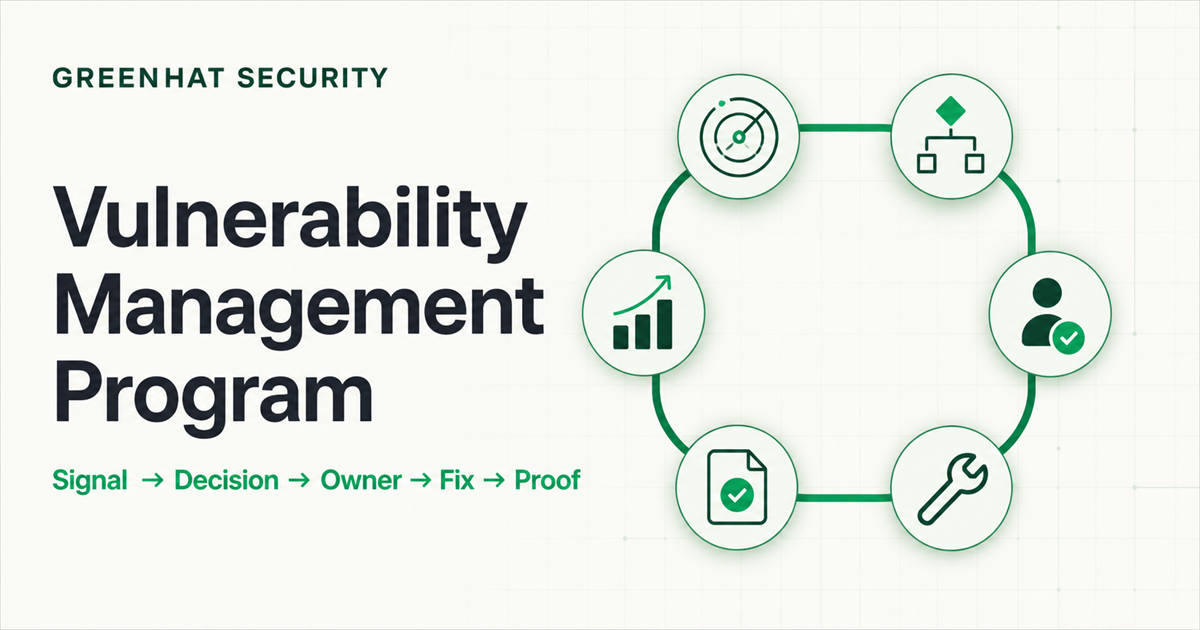
The program should behave like a control loop, not a collection of disconnected reports. Every signal moves through the same six decisions, while emergency vulnerabilities take a faster path through the loop. The exact tools can change without changing the operating model.
NIST describes enterprise patch management as identifying, prioritizing, acquiring, installing, and verifying updates. A broader vulnerability management program applies that discipline to configuration changes, compensating controls, service removal, vendor mitigations, and accepted risk as well as patches.
- Govern and scope: approve the charter, authorized targets, RACI, risk authority, response targets, and emergency path.
- Discover: reconcile assets and ingest findings from infrastructure, cloud, applications, dependencies, testing, advisories, and disclosure channels.
- Validate and enrich: confirm the affected component, deduplicate instances, check assessment quality, and add exposure, owner, and business context.
- Prioritize and decide: choose patch, upgrade, configuration change, mitigation, replacement, or time-bound risk acceptance.
- Remediate: route work to an accountable team with deployment testing, rollback planning, escalation, and evidence requirements.
- Verify and improve: rescan or retest, reopen failed fixes, retain closure evidence, and use recurring findings to improve architecture and configuration.
The operating model
Signal → decision → owner → fix → proof
- 01Govern & scopeCharter, services, owners, authority, and response rules
- 02DiscoverAssets and findings from every material assessment source
- 03Validate & enrichPresence, reachability, exposure, ownership, and impact
- 04Prioritize & decideExploit evidence, likelihood, severity, context, and controls
- 05RemediateFix, mitigate, replace, remove, or accept with an expiry
- 06Verify & improveRetest, retain evidence, reopen failures, and prevent recurrence
Start with scope, assets, and accountable owners
A backlog cannot be trusted when the organization cannot explain what should have been assessed. Start with business services and the technology that supports them, then reconcile the sources that know about endpoints, servers, cloud accounts, containers, network devices, applications, APIs, repositories, dependencies, SaaS, and operational technology where applicable.
Every in-scope asset should carry enough context to support a decision: business service, technical and risk owner, criticality, internet exposure, data sensitivity, environment, support status, and assessment method. Do not wait for a perfect configuration management database. Begin with crown-jewel and internet-facing services, record gaps, and improve coverage deliberately.
Minimum program foundation
- Charter and policyPurpose, scope, authority, risk appetite, service boundaries, and review cadence.
- Asset data standardRequired owner, service, criticality, exposure, data, environment, and support fields.
- Assessment coverageInfrastructure, endpoint, cloud, application, API, dependency, container, and external sources.
- RACI and escalationSponsor, program lead, service owners, delivery teams, risk authority, and emergency contacts.
- Decision standardPriority factors, treatments, response targets, exception approvals, and expiry rules.
- Closure evidenceRequired rescan, retest, configuration proof, mitigation validation, and record retention.
Prioritize risk, not one score
A CVSS Base score describes technical severity. It does not tell you whether a vulnerable component exists in your environment, whether an attacker can reach it, or what the affected service means to the business. Use it as one input rather than the queue order.
Start with evidence of exploitation. The CISA Known Exploited Vulnerabilities Catalog is a high-confidence source for vulnerabilities exploited in the wild. Then add presence and reachability, internet exposure, privilege or attack-path position, business criticality, and data sensitivity. Use FIRST's Exploit Prediction Scoring System as a likelihood signal and CVSS v4 Threat and Environmental context to enrich technical severity. Finish with existing controls, patch safety, vendor support, and operational impact.
Do not multiply EPSS and CVSS into a made-up universal risk score. Keep the underlying signals visible so reviewers can understand why one vulnerable instance moves ahead of another. A lightweight decision tree is often easier to govern than a complex formula nobody can explain.
A practical prioritization stack
| Signal | Question it answers | Decision use |
|---|---|---|
| Known exploitation | Is there credible evidence attackers are using it? | Trigger emergency review or accelerate mitigation |
| Presence and reachability | Is the affected component installed and reachable? | Validate the vulnerable instance and likely attack path |
| Business context | What service, data, or operation could be harmed? | Set materiality and accountable risk owner |
| Likelihood and severity | How likely and technically serious is exploitation? | Use EPSS, CVSS, and threat intelligence as inputs |
| Controls and feasibility | What reduces exposure and what treatment is safe? | Choose patch, mitigation, isolation, replacement, or acceptance |
Authoritative prioritization references
Exploitation
CISA Known Exploited Vulnerabilities Catalog
Use confirmed in-the-wild exploitation as an explicit prioritization input.
Decision Model
CISA Stakeholder-Specific Vulnerability Categorization
Review a decision-tree approach using exploitation status, technical impact, automatability, mission prevalence, and public-well-being impact.
Likelihood
FIRST EPSS Guidance
Use exploitation probability as a changing likelihood signal, not a complete risk score.
Severity Context
FIRST CVSS v4 Consumer Guide
Add threat and environmental context instead of sorting only by the Base score.
Make remediation and exceptions operational
A program should permit more than patching. Teams may upgrade a component, change configuration, remove a service, restrict access, segment a network, apply virtual patching, use a vendor mitigation, replace unsupported technology, or accept the residual risk. The record should show the decision, owner, target date, dependencies, and evidence required for closure.
Response targets should reflect the organization's risk appetite, customer commitments, regulations, and operational constraints. They should become shorter when active exploitation, internet exposure, sensitive data, critical services, or dangerous attack paths are present. Emergency work also needs deployment rings, testing, rollback, and an executive escalation route so urgency does not create a second incident.
Risk acceptance is a treatment, not a way to hide backlog. Require a named risk owner, rationale, compensating controls, review date, expiry date, and re-entry condition. Expired exceptions should return to triage automatically. If an external assessor may later review the same environment, document GreenHat's advisory, operational, and assurance boundaries before delivery begins.
A finding is ready to close when
- The treatment is implementedThe patch, configuration, mitigation, isolation, replacement, or removal reached the affected instance.
- The exposure is retestedA rescan, targeted test, or control validation confirms the expected result.
- Evidence is attachedThe record shows what changed, when, by whom, and how closure was verified.
- Failures reopen the workPartial deployment, failed validation, or recurrence returns the instance to an accountable queue.
Build the first 90 days in three releases
Treat this as a planning model, not a delivery guarantee. The first release should create control over the most important exposure, the second should make the workflow repeatable, and the third should make results measurable. Expand scope only as fast as the team can preserve ownership and data quality.
Appoint the executive sponsor and program lead. Approve a one-page charter, RACI, authorized scope, sensitive-finding handling, response targets, exception form, and evidence standard. Inventory crown-jewel and internet-facing services first, then reconcile their owners and assessment sources.
Run the baseline, check applicable CISA KEV entries immediately, and separate vulnerable instances from duplicate findings. Record the gaps where assets could not be authenticated, reached, or assessed instead of presenting partial coverage as complete.
CISO outputs
- Named sponsor, program lead, service owners, and risk authority
- Approved scope, RACI, emergency path, and exception standard
- Baseline for crown-jewel and internet-facing services
- Applicable KEV review with owners and immediate decisions
Normalize findings into one system of record and enrich them with KEV, EPSS, exposure, service criticality, owner, and CVSS context. Pilot weekly triage with a small set of service teams before automating every ticket.
Define deployment rings, rollback expectations, overdue escalation, and the evidence needed for fixes and compensating controls. Baseline coverage and flow metrics without turning the first month into a performance target.
CISO outputs
- Canonical vulnerable-instance record and ownership routing
- Repeatable priority decision tree and response targets
- Weekly triage, emergency escalation, and patch deployment path
- Initial coverage, backlog-age, exception, and verification baseline
Automate ownership routing, aging alerts, retesting, and exception expiry after the pilot exposes the edge cases. Add application, dependency, container, infrastructure-as-code, advisory, penetration-test, and disclosure inputs that are material to the environment.
Tabletop an actively exploited vulnerability, inspect failed and reopened fixes, and review the dashboard with executives and service owners. Use the results to set the next quarter's coverage and unsupported-technology priorities.
CISO outputs
- Retesting, evidence, aging, and exception-expiry workflow
- Emergency vulnerability tabletop and improvement actions
- Operational and executive dashboards with clear definitions
- Quarter-two plan for coverage, recurrence, and technology debt
Use metrics that show exposure reduction
A raw vulnerability count is easy to produce and hard to interpret. It can rise because coverage improved or fall because an assessment failed. Average CVSS and average remediation time can also hide a small number of consequential exposures. Measures should be obtainable, repeatable, tied to program decisions, and separated by service or priority where that context matters.
Leadership-ready measures
- CoverageIn-scope assets with owners and criticality, assessed within cadence, plus authenticated-assessment success.
- Material exposureOpen and overdue KEVs, exposed critical services, oldest high-priority instance, and unsupported technology.
- FlowMedian and 90th-percentile time to triage and remediate, response-target compliance, and verification latency.
- Decision qualityUnassigned work, exception age and expiry, compensating-control status, reopen rate, and recurring findings.
- Change safetyFirst-pass fix success, rollback or disruption rate, and emergency-work review actions.
- Risk trendRisk-weighted backlog and burn-down by business service, not one company-wide vanity number.
Set a cadence the organization can sustain
Review credible active exploitation and urgent vendor advisories daily. Hold operational triage weekly, including overdue work and failed remediation. Review material exposures, exception decisions, and support needs with the steering group monthly. Reconcile coverage, thresholds, unsupported technology, and recurring root causes quarterly. Refresh the charter, policy, risk appetite, and roadmap at least annually or after a material change.
The program lead owns methodology, triage quality, and reporting. Asset or service owners remain accountable for remediation or risk acceptance. Technology teams implement and test changes; threat intelligence and incident response provide exploitation context; GRC or another risk authority governs exceptions. Smaller organizations can combine roles, but they should not erase accountability.
Use tools to support this model rather than define it. Before buying another platform, decide which source is authoritative for assets, owners, tickets, exceptions, closure evidence, and reporting. Integration quality, assessment reach, data export, APIs, role-based access, and evidence retention often matter more than the size of a vendor's vulnerability feed.
Program Design
Turn the backlog into an operating model
GreenHat can help assess the current state, define governance and prioritization, design remediation and exception workflows, and build a measurable 90-day roadmap around the tools you already use.
Vulnerability management program FAQ
These answers separate the operating program from the scanners, penetration tests, disclosure channels, and compliance activities that may feed it.
It is the continuous process for governing scope, discovering and validating vulnerable instances, prioritizing risk, assigning decisions, remediating or accepting exposure, verifying closure, and reporting outcomes. It includes tools, but the program is the operating model around them.
Use a risk-based cadence and reassess after material changes or relevant disclosures. Internet-facing and critical services usually need more frequent visibility than low-impact isolated systems. Also monitor assessment freshness and authentication success so a scheduled scan is not mistaken for effective coverage.
No. Confirm that the component is present, then weigh active exploitation, reachability, exposure, business impact, likelihood, technical severity, and existing controls. A known-exploited vulnerability on a reachable critical service can deserve action before a higher Base score on an isolated or absent component.
Choose another treatment such as configuration change, access restriction, segmentation, virtual patching, service removal, vendor mitigation, or technology replacement. If risk is accepted, name the risk owner, document compensating controls, set an expiry, and define what would force the decision back into triage.
No. A penetration test is a scoped, usually point-in-time exercise that uses human judgment to validate weaknesses and attack paths. A vulnerability management program continuously receives findings from scanners, penetration tests, advisories, incidents, and other sources, then drives decisions through verified closure.
No. Vulnerability management is the internal process for reducing exposure. A vulnerability disclosure program is the public channel and policy used by external researchers to report potential security issues. Disclosure reports can become an intake source for vulnerability management, but the two programs have different scopes and responsibilities.
Yes. The operating model in this guide is tool-agnostic. A program assessment should first determine which asset, assessment, ticketing, risk, and reporting systems are already useful, where the data breaks down, and what integration or process changes are actually required.
No. It can support security and compliance objectives by making exposure decisions repeatable and auditable, but no program eliminates vulnerabilities or guarantees that an incident will not occur. Outcomes depend on scope, authority, data quality, operational follow-through, and the changing threat environment.
Turn your findings backlog into an operating program
GreenHat can help assess the current state, define program ownership and service boundaries, build the prioritization and exception model, map the first 90 days, and design reporting that leadership and service owners can act on.
Before delivery begins, we will make the engagement boundary explicit: advisory design, implementation support, co-managed operations, scanner execution, patch deployment, and independent assurance are different responsibilities and should not be implied by one label.
Related GreenHat Resources
Continue into the adjacent tools, guides, and service pages that help turn this topic into action.
GreenHat Link
GreenHat Vulnerability Research Program
Explore GreenHat researchers and published CVEs grouped by the software they affect.
GreenHat Link
Cybersecurity Risk Assessment Guide
Define impact, likelihood, risk treatment, and leadership decisions around cyber exposure.
GreenHat Link
Cyber Risk Matrix Builder
Create a browser-based risk register and 5x5 matrix for leadership discussions.
GreenHat Link
Virtual CISO Services
Add senior security leadership for program governance, operating cadence, and executive reporting.
GreenHat Link
Compliance by Security
Build operating controls that reduce real risk and produce useful evidence as a byproduct.
GreenHat Link
AI Agent Incident Response Checklist
Prepare a containment, evidence, access-revocation, and recovery sequence for autonomous AI systems.
Source and further reading
This GreenHat page cites Guide to Enterprise Patch Management Planning: Preventive Maintenance for Technology from NIST. The primary source and supporting references used for this guide are collected below.
Standards and primary references
NIST
NIST SP 800-40 Rev. 4
Enterprise patch management planning, prioritization, deployment, and verification guidance.
NIST
NIST Cybersecurity Framework 2.0
A risk-based framework for governing and managing cybersecurity outcomes.
CISA
CISA Known Exploited Vulnerabilities Catalog
A living catalog of vulnerabilities with evidence of exploitation in the wild.
CISA
CISA SSVC Guide
A stakeholder-specific decision model for vulnerability prioritization.
FIRST
FIRST EPSS Guidance
Guidance for using probability of exploitation as one prioritization signal.
FIRST
FIRST CVSS v4 Consumer Implementation Guide
Guidance for using Base, Threat, and Environmental metrics in context.
OWASP
OWASP Vulnerability Management Guide
Open guidance on designing a repeatable vulnerability management process.